
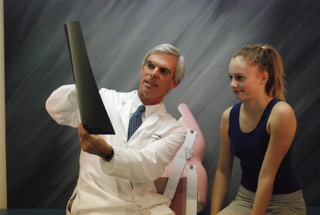
 C. RALPH HOOPER, JR, CPO
Founder & Inventor of the Charleston Bending Brace
The Charleston Bending Brace (CBB) was developed in 1979 as a time-modified orthosis for adolescent idiopathic scoliosis, designed for night-time-only wear in appropriately selected patients.
Mr. Hooper, a certified orthotist/prosthetist based in Charleston SC collaborated with pediatric orthopedic surgeon Frederic E. Reed, MD to develop a side bending orthosis intended to optimize corrective positioning during sleep.
The idea was simple but innovative
- Use controlled side-bending positioning during sleep
- Improve comfort and daily quality of life
- Support better brace wear compliance
- Provide an effective option for select patients
Development & Clinical Investigation
Concept Origin (1979)
Initiated following a personal family diagnosis of AIS and concerns regarding compliance challenges associated with full-time bracing
Clinical Investigation (1984)
An investigative team was assembled to evaluate side-bending, time-modified bracing for curves commonly cited a ≤40, depending on the skeletal maturity and curve pattern.
Patent (1987)
The Charl BB received patent protection following iterative clinical refinement.
Clinical Positioning
- The CBB is generally prescribed for select AIS curves
- Skeletally immature patients
- Curve magnitudes commonly in the mild-to-moderate range
- Situations where full-time brace adherence may be compromised
It is not positioned as a universal replacement for full-time TLSO bracing but as an evidence-supported alternative when appropriately indicated.
Research Record
Since initial development, more than 25 peer-reviewed publications have evaluated outcomes associated with night-time side-bending bracing.
For full citations, see the Resources section
Continuing Legacy
The Charleston Bending Brace represents one of the earliest most widely studied night-time bracing concepts and continues to be utilized within multidisciplinary scoliosis management